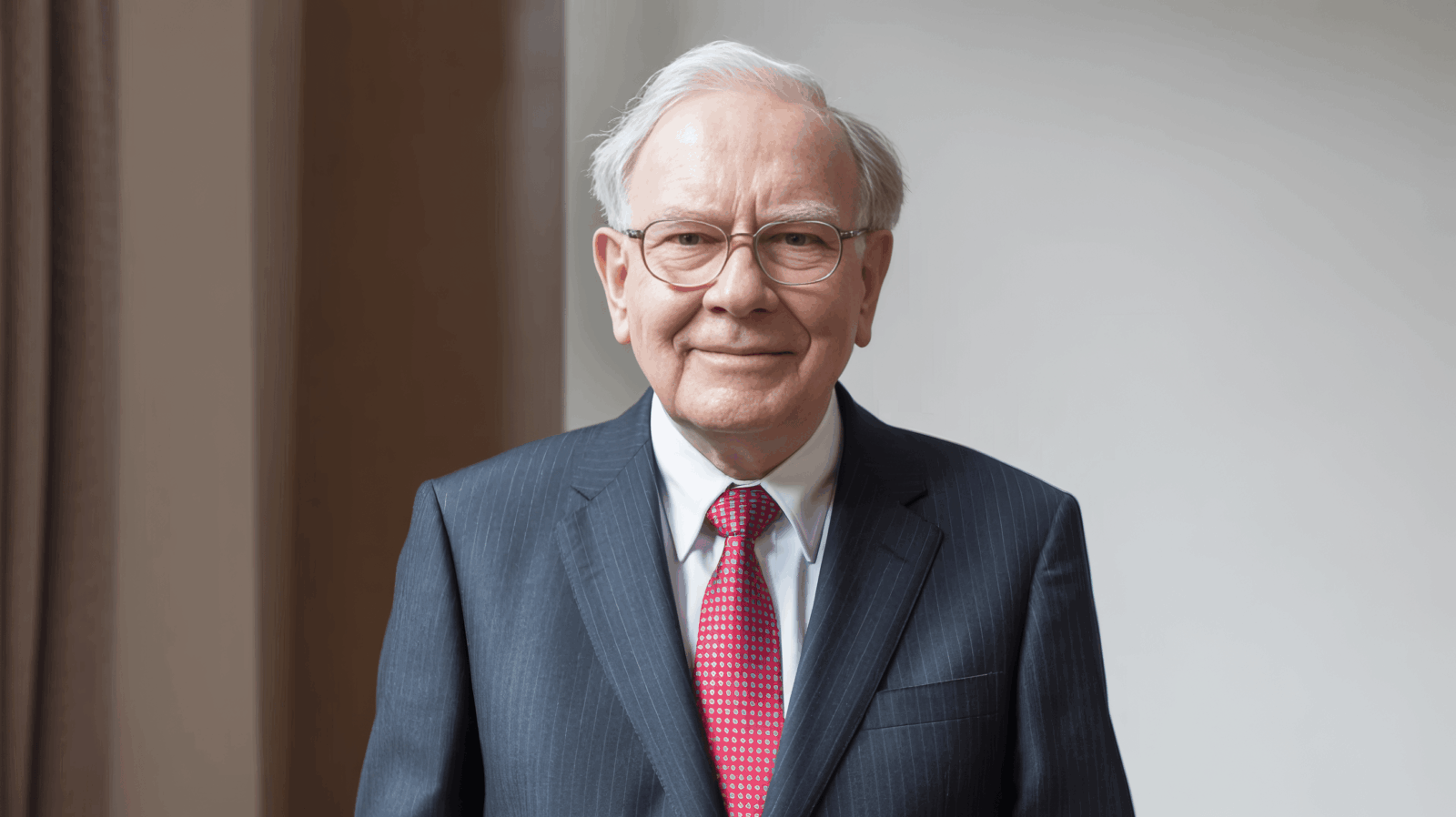
Warren Buffett never gave his formula for the algebra of wealth, but his decades of shareholder letters and interviews outline a very specific formula for financial success. If we were to express his philosophy as a mathematical equation, it would look something like this:
W = (C × R^n) − (F + E)
Where W is Wealth, C is Capital invested early and consistently, R is the Rate of Return through compounding, n is Time as the most critical factor, F is Fees and Friction including taxes and trading costs, and E is Ego representing emotional mistakes. The math itself isn’t complicated, and that’s the point.
What separates Buffett from almost every other investor is the discipline he brings to each variable. He treats wealth as the predictable output of patience, quality investments, and self-control rather than the result of brilliance or luck.
1. C: Capital Must Be Deployed Early and Consistently
“The stock market is a device for transferring money from the impatient to the patient.” – Warren Buffett.
Capital is the seed of the equation, and Buffett believes in planting it steadily rather than waiting for the perfect entry point. He has long advocated for ordinary investors to put money into low-cost index funds on a regular schedule, allowing consistent contributions to do the work that market timing can’t.
He treats downturns as opportunities to buy more, not signals to sell when you are holding the right stocks or indexes. His willingness to deploy cash during the 2008 financial crisis, while others sold in panic, illustrates how steady capital allocation outperforms emotional reactions over a full market cycle.
2. R: The Rate of Return Depends on Quality
“It’s far better to buy a wonderful company at a fair price than a fair company at a wonderful price.” – Warren Buffett.
Buffett doesn’t chase the highest returns; he chases the most reliable ones. The rate of return in his formula comes from what he calls a moat, a durable competitive advantage that protects a business from competitors over decades.
A high return that lasts for 12 years means little if the company collapses in 2 years. He prefers steady compounders such as Coca-Cola, American Express, and Apple because their pricing power and customer loyalty allow earnings to grow predictably year after year.
3. n: Time Is the Exponent That Does the Heavy Lifting
“Our favorite holding period is forever.” – Warren Buffett.
In Buffett’s algebra, time is the exponent that does most of the work. He started purchasing stocks at age eleven and is now in his nineties, meaning his capital has been compounding for more than 80 years without serious interruption.
Much of his net worth was built later in life, a fact he often references when explaining why young investors hold the most valuable edge on Wall Street. Anyone with modest but consistent savings can replicate the mechanics of compounding, but only those who refuse to interrupt the process get to see the curve bend sharply upward in the final stretch.
4. F: Fees and Friction Quietly Drain Wealth
“When trillions of dollars are managed by Wall Streeters charging high fees, it will usually be the managers who reap outsized profits, not the clients.” – Warren Buffett.
Every percentage point lost to fees is a permanent leak in the compounding bucket. Buffett has spent years warning investors that hedge funds, advisors, and active mutual fund managers extract returns that should belong to their clients.
He famously won a ten-year bet against a basket of hedge funds, with a simple S&P 500 index fund outperforming them once fees were accounted for. His advice for the average investor is direct: minimize costs, minimize trading, and let the market do its work without interference.
The F also stands for the frictional tax on capital gains and dividends. Buffett treats taxes as one of the most underappreciated drags in the wealth equation, which is why he has held core positions like Coca-Cola and American Express for decades rather than trading them for marginal gains.
Every time an investor sells a winning position, the government takes a cut, and that lost capital can no longer compound. Buffett often points out that a stock held for thirty years and sold once will produce a dramatically larger after-tax return than the same stock traded repeatedly over the same period, even if the gross returns are identical.
His tax optimization strategy is simple in principle: buy quality businesses, hold them as long as possible, let unrealized gains compound tax-free inside the position, and use tax-advantaged accounts like IRAs and 401(k)s whenever available.
He has also noted that the best holding period allows an investor to defer capital gains indefinitely, turning the tax code itself into a silent partner in the compounding process rather than a recurring expense that quietly subtracts from returns year after year.
5. E: Ego Is the Most Dangerous Subtraction
“Success in investing doesn’t correlate with IQ. What you need is the temperament to control the urges that get other people into trouble in investing.” – Warren Buffett.
Buffett argues that investing is far more about emotional discipline than raw intelligence. The errors that cost investors the most are not analytical mistakes but psychological ones, including overtrading, chasing trends too late, and panic selling at market lows.
He has often described the typical investor’s worst enemy as their own reflection in the mirror. Buying when others are greedy and selling when others are fearful is the most common way capital gets destroyed, and avoiding those impulses is what separates successful investors from average ones.
6. Stay Inside Your Circle of Competence
“You only have to be able to evaluate companies within your circle of competence. The size of that circle is not very important; knowing its boundaries, however, is vital.” – Warren Buffett.
Buffett refuses to invest in businesses he doesn’t understand, which is why he avoided most technology stocks for the bulk of his career. His circle of competence is a self-imposed boundary that prevents him from making decisions based on hype or incomplete information.
The lesson for individual investors is straightforward: don’t try to value a business if you can’t clearly explain how it makes money. Owning index funds, holding shares in industries you genuinely understand, and ignoring the rest is a more reliable path than guessing at companies whose business models confuse you.
7. Always Demand a Margin of Safety
“We insist on a margin of safety in our purchase price.” – Warren Buffett
The margin of safety, a concept Buffett inherited from his mentor Benjamin Graham, is the cushion between an asset’s value and what an investor pays for it. Buying at a discount means that even if your analysis is slightly wrong, you still have room to absorb the error without taking a permanent loss.
It is the financial equivalent of building a bridge that can hold thirty thousand pounds when only ten thousand will ever cross it. That cushion is what keeps small mistakes from compounding into catastrophic ones.
8. Price Is Not the Same as Value
“Price is what you pay. Value is what you get.” – Warren Buffett
The most quoted line in Buffett’s library captures the heart of his philosophy. The market quotes prices every minute of every trading day, but value is determined by the long-term cash a business generates for its owners.
A stock can be expensive at $10 and cheap at $100, depending entirely on the underlying business. Investors who confuse the two end up buying overpriced assets in good times and selling discounted ones in bad times.
Conclusion
Buffett’s algebra of wealth isn’t a secret formula reserved for geniuses. It’s basic arithmetic applied with patience, humility, and self-control over a long enough timeline.
Capital, compounded at a steady rate over many years, will outpace almost any get-rich-quick strategy that ignores fees, quality, or emotion. The variables are simple, but most investors fail because they refuse to respect the equation.
Buffett’s advantage has never been an unusually high IQ or a hidden mathematical edge. It is his refusal to let unnecessary costs and psychological mistakes subtract from his compounding, year after year, decade after decade.
PakarPBN
A Private Blog Network (PBN) is a collection of websites that are controlled by a single individual or organization and used primarily to build backlinks to a “money site” in order to influence its ranking in search engines such as Google. The core idea behind a PBN is based on the importance of backlinks in Google’s ranking algorithm. Since Google views backlinks as signals of authority and trust, some website owners attempt to artificially create these signals through a controlled network of sites.
In a typical PBN setup, the owner acquires expired or aged domains that already have existing authority, backlinks, and history. These domains are rebuilt with new content and hosted separately, often using different IP addresses, hosting providers, themes, and ownership details to make them appear unrelated. Within the content published on these sites, links are strategically placed that point to the main website the owner wants to rank higher. By doing this, the owner attempts to pass link equity (also known as “link juice”) from the PBN sites to the target website.
The purpose of a PBN is to give the impression that the target website is naturally earning links from multiple independent sources. If done effectively, this can temporarily improve keyword rankings, increase organic visibility, and drive more traffic from search results.